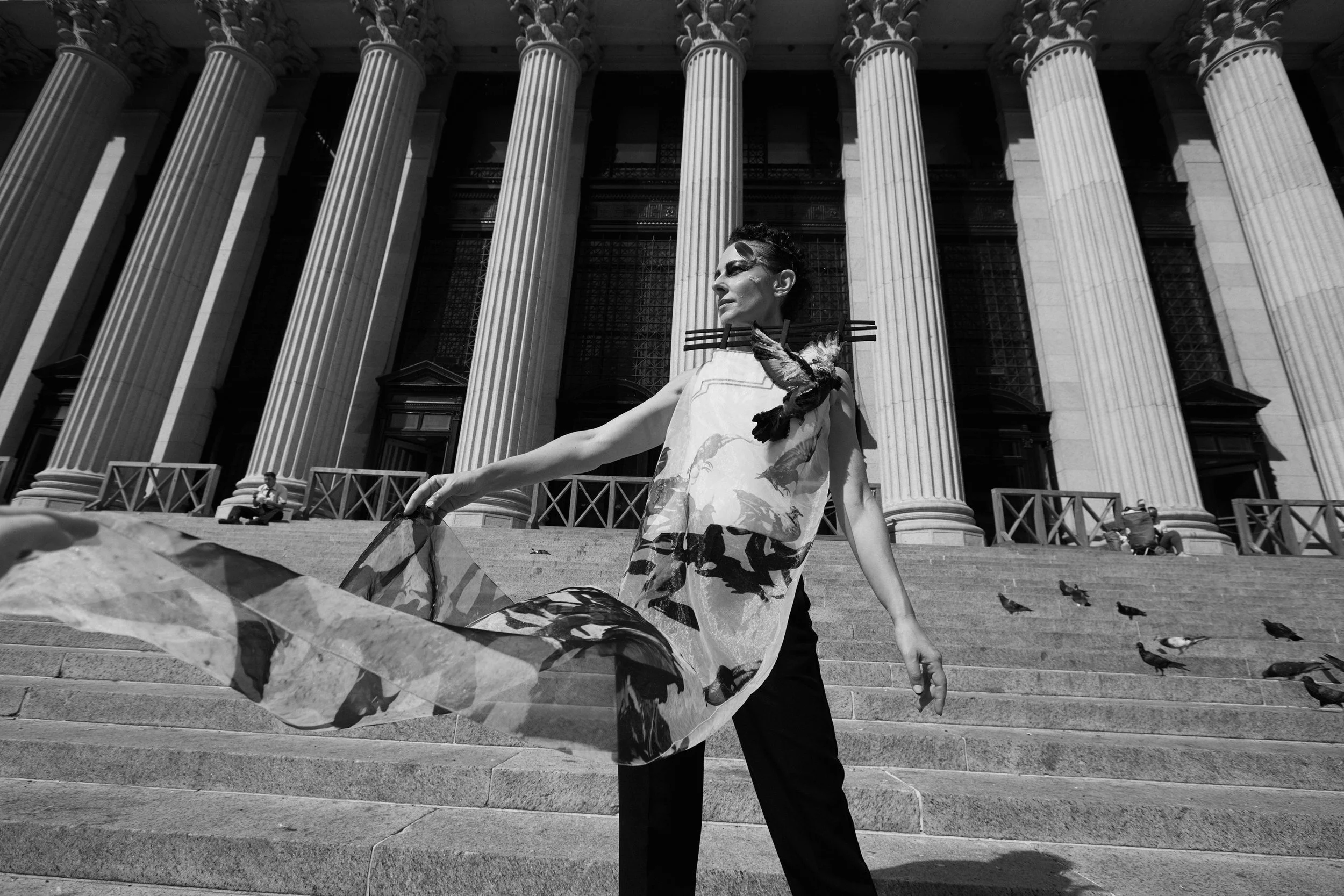
Captured on the city’s steps in a rush of wings, the moment becomes Adaptress.


Because in New York,
survival is an art,
and sometimes it
comes with feathers.
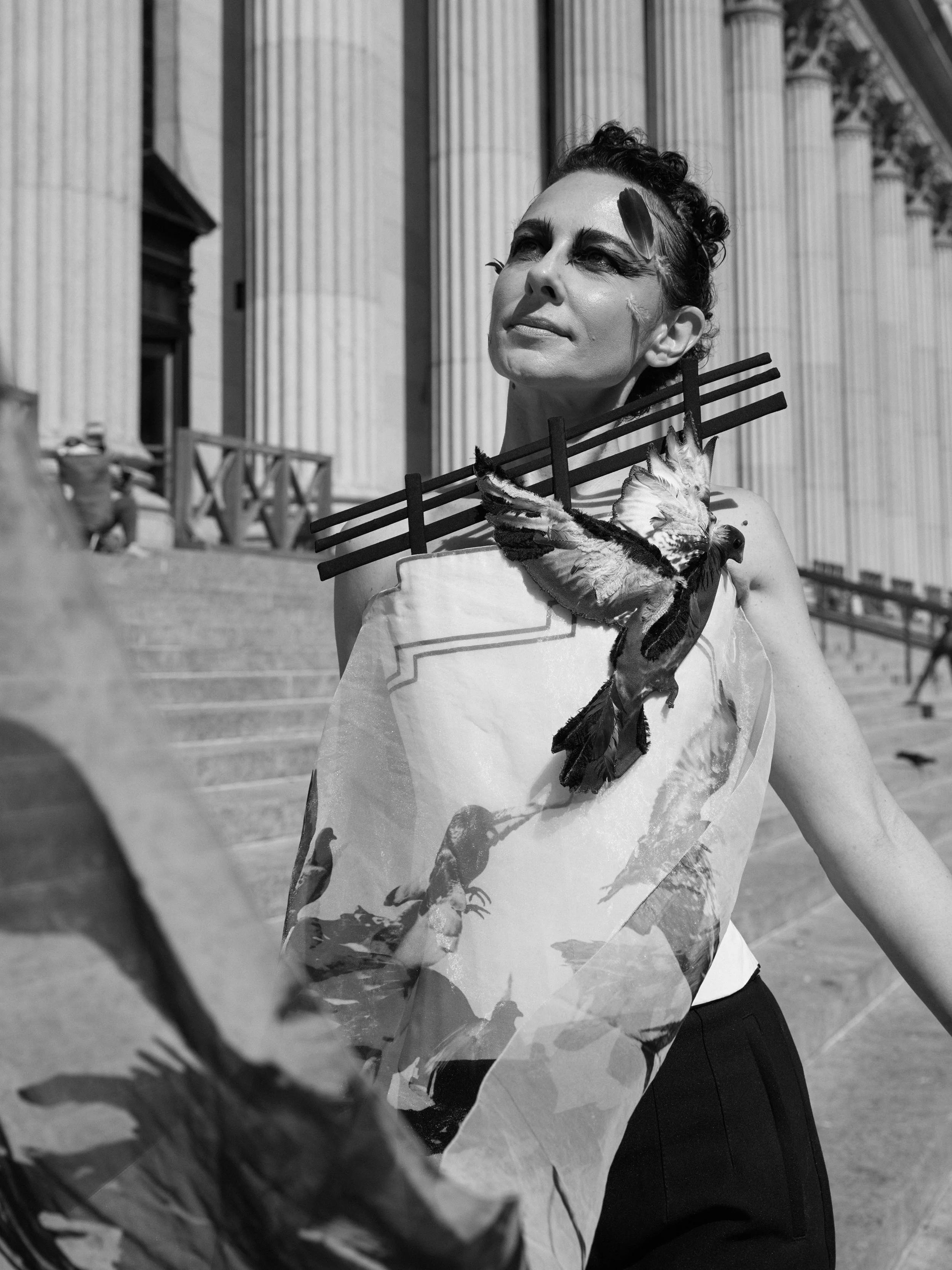


Adaptress
Pigeons, Feathers, and the Art of Adapting to New York
Pigeons accompany me everywhere as I walk through the city, faithful companions and occasional divas who never miss the opportunity to wander into my street shots. They are my muse, and they amuse me.
One late summer afternoon, I sat in the bright noon sun on the stairs of the James A. Farley Building, waiting for the right moment. I wanted a close-up, a fleeting instant just as a few pigeons prepared to take flight. Then a woman stopped, pulled out a bag of breadcrumbs, and scattered them across the steps. Within seconds, hundreds of pigeons clustered into a feeding frenzy. That was my moment to come out and play. I stepped into the flock, triggering a rush of wings, and captured the shot I had been waiting for.
Pigeons carry an unbothered New Yorker energy, strutting through crowds like they own the street, if not the stations too. We move through New York as sidewalk co-conspirators until it gets too close for comfort. Competition kicks in for the same square foot of space. You’re almost stepping into each other when suddenly the pigeon, bored, reroutes at a sharp ninety-degree angle or retaliates by flying away, narrowly missing your face. They are neither visitors nor symbols; they are simply here, adapting in plain sight.
I wanted to dedicate one of the Embodied Moments NYC outfits to the New York pigeon because, beyond sharing the same city, I began to see how much we had in common, and not just wings. As an immigrant, I had to learn to adapt again and again in one of the most relentless cities in the world. As Carrie Bradshaw once said, “In New York, you're always looking for a job, a boyfriend, or an apartment.” Pigeons, in their own way, are doing the same: scouting crumbs, courting partners, and touring potential real estate one ledge at a time.
Adaptress took flight from the photograph I captured on the Farley Building stairs. To echo that raw architectural setting, I began at the ground with sharply tailored black pants. Above them, a white corset rises, its edges cut into the silhouette of the stairs and traced in black ribbon. Across the top, a bold grid of black boning mirrors the rigid geometry of the railings, together forming one of Estelle’s most technically intricate constructions. These structured layers became a runway for the pigeons, while the photograph, printed on airy poly organza, forms the ensemble’s only free-moving element. At the center, the protagonist pigeon rises from my chest mid-flight, printed on cotton canvas and embroidered with real feathers and fabric trimmings.
I spent hours visiting pigeon-gathering spots wearing disposable gloves, carrying a bag and collecting fallen feathers, while trying to disregard the what-is-she-doing stares from pigeons and humans alike.
What began as something discarded on the street slowly became material: texture, structure, and memory. Back home, I cleaned the feathers with spray sanitizer and placed them on a baking grid to dry. Sarah and I then spent hours studying and playing with them, mapping direction, density, and rhythm into patterns for the cotton-canvas bird.
We learned a lot about pigeons through their feathers. They are never simply black, blue-grey, white, or silver; many carry a subtle yellow-brown warmth. At first I blamed the sanitizer for altering their tones. Then, in the window directly opposite Sarah’s apartment, a pair of pigeons built a nest atop an air-conditioning unit. She watched as eggs appeared and, not long after, two tiny squabs hatched in soft golden down. As I visited, I witnessed their transformation too, gradually shifting into the familiar blue-black-grey of adulthood, as if traces of that earliest warmth lingered in the feathers that followed.
Finally, all the pieces came together. Adaptress was ready, and I was ready to join my streetmates.
I felt like a bird, and I looked like one. Weronika covered my face and hair with real feathers and gave me oversized dark smoky eyes, extending laterally beyond my own, with hints of short feathers around the edges.
Of course, the pigeons had to be part of the shoot. I wasn’t about to stand on those majestic stairs as a lonely bird. We lured my playmates with seeds, Laur ran through the flock to send them into flight, and Emeline filmed me moving among them. It was fun, chaotic, unpredictable, and alive. I became one of them: waiting, sitting still, observing, looking to the sky, then mimicking their flight by floating the organza into the air.
Adaptress carries that tension, grit and elegance at once. The tailored structure echoes the city’s architecture, while the flowing organza moves like wings against the skyline. Like pigeons, we learn to navigate the city on instinct, waiting for the right seeds to fall, hoping they lead us toward the next job, love, or apartment.
Perhaps that’s why pigeons stay with us: amusing, unbothered companions, quietly reminding us to spread our wings, let go a feather or two, and move with the rhythm of the city.
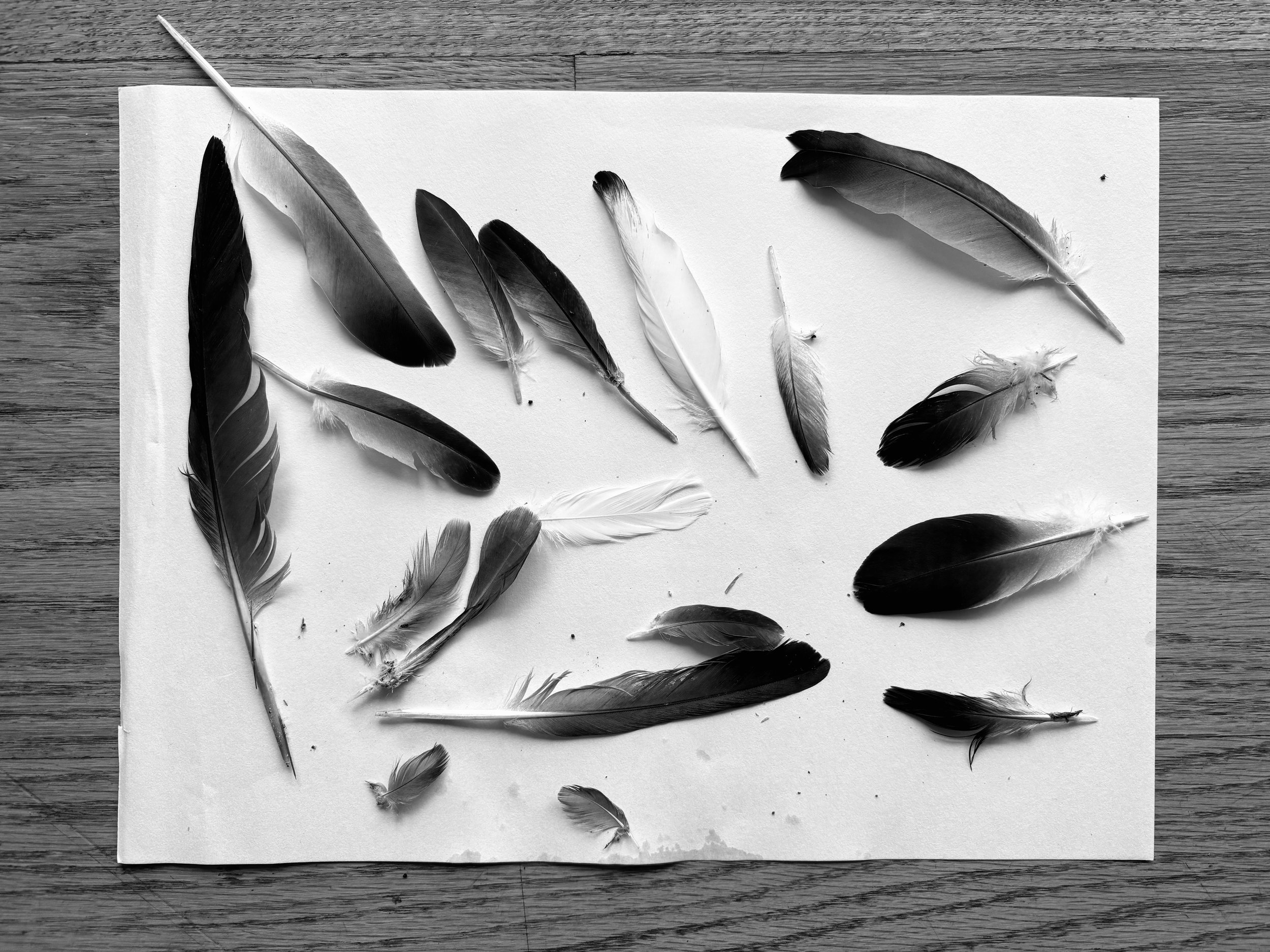
From street-found feathers to a living form, this is how Adaptress took shape.


